Portfolios drift. It's not a failure — it's mathematics. When some positions outperform others, the portfolio's actual allocation diverges from the intended allocation. Left unmanaged, this drift creates risk concentrations and factor exposures you didn't plan for.
Rebalancing is the systematic practice of correcting this drift — bringing the portfolio back into alignment with your intended structure and risk profile.
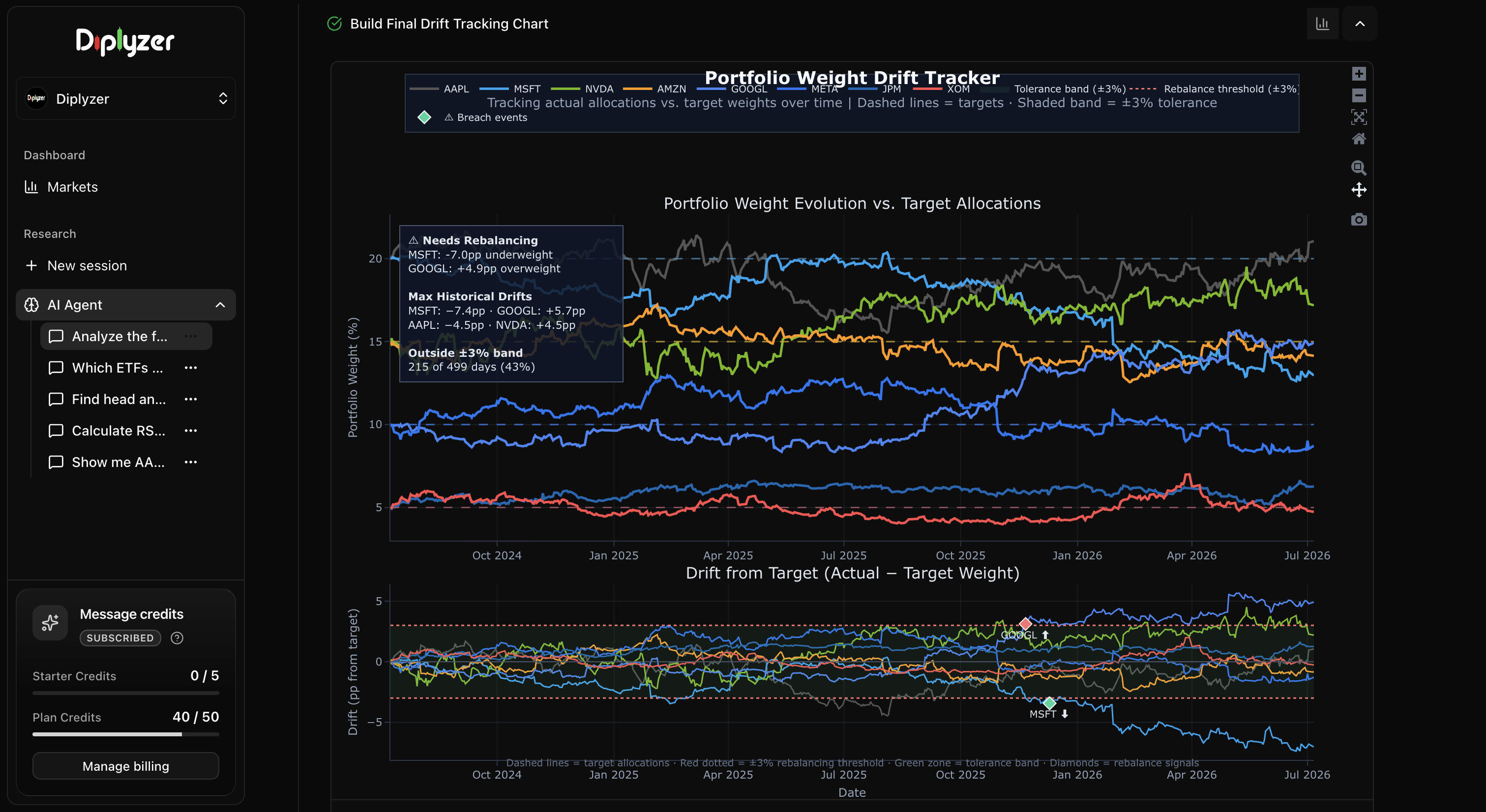
Why Portfolios Drift (And Why It Matters)
Consider a simple example: a portfolio that starts as 60% equities and 40% bonds. After a strong equity bull market, equities might represent 75% of the portfolio while bonds have shrunk to 25%.
This is now a fundamentally different portfolio — it has more equity risk, less fixed income ballast, and is no longer aligned with the intended 60/40 structure. The investor didn't make any active decision to become more aggressive — but they became so passively through drift.
Why drift matters:
Risk creep: Winners grow large and become a bigger portion of the portfolio than intended. Your risk profile shifts without you realizing it.
Mean reversion exposure: Positions that have grown large due to strong recent performance are often statistically more likely to mean-revert. Rebalancing trims winners that are getting extended.
Factor concentration: As certain factors outperform (e.g., momentum, growth), portfolios built from stocks with those factor exposures can become heavily concentrated in a single factor without any individual stock changing.
Benchmark deviation: If you maintain a target allocation, drift causes your portfolio to increasingly deviate from that target — making it harder to evaluate your active decisions against the intended structure.
Rebalancing Approaches
There is no single universally optimal rebalancing approach. The right method depends on your portfolio size, tax situation, trading costs, and tolerance for drift.
Calendar Rebalancing
Rebalance on a fixed schedule regardless of drift magnitude — monthly, quarterly, or annually.
Pros: Simple, disciplined, easy to follow Cons: May rebalance unnecessarily when drift is minor; may not rebalance quickly enough when drift is significant
Best for: Long-term, passive-oriented portfolios where simplicity and consistency matter more than optimization
Research finding: Annual rebalancing is almost as effective as more frequent rebalancing for long-term investors, with lower transaction costs.
Threshold-Based (Percentage Band) Rebalancing
Rebalance only when a position or asset class drifts more than a set percentage from its target weight.
Example: A position with a 5% target weight triggers a rebalance if it grows above 7% or falls below 3% of the portfolio (a ±2% band).
Pros: Avoids unnecessary trading during small fluctuations; responds to meaningful drift Cons: Requires ongoing monitoring; in trending markets, can delay rebalancing when drift accelerates quickly
Common threshold bands:
| Portfolio Type | Typical Band |
|---|
| Individual stock positions | ±2–3% of target weight |
| Sector allocation | ±5% of target |
| Asset class (equities vs. bonds) | ±5–10% of target |
Hybrid Approach (Calendar + Threshold)
Review the portfolio on a calendar schedule (quarterly or monthly), but only execute rebalancing trades when positions have drifted beyond a set threshold.
This is the most commonly recommended approach for active portfolio managers — it combines systematic review with threshold-based execution discipline.
AI Prompt
"Review my current portfolio allocation [list positions and sizes]. My target benchmark weights are [describe targets]. Which positions have drifted more than 2% from their target weights? Calculate the exact mathematical dollar variance and percentage drift for each position."
What to Rebalance Back To
This is a nuance that many investors miss: you should rebalance back to your current strategic target, not necessarily your original target.
Example: If you originally set technology at 20% of your portfolio, but the sector has fundamentally changed in importance (as it has over the last decade), your strategic target for technology may now legitimately be 25% or 30%. Rebalancing back to 20% based on an outdated target would be wrong.
Rebalancing is not just a mechanical process — it is also an occasion to review whether your strategic targets themselves need updating.
Tax-Efficient Rebalancing
For investors in taxable accounts, rebalancing can trigger capital gains taxes that significantly reduce the net benefit. Tax-aware rebalancing minimizes this friction.
Tax-Loss Harvesting
When rebalancing requires selling winners (to reduce overweight positions), simultaneously look for positions with unrealized losses to sell. The losses offset the gains, reducing or eliminating the tax bill.
The wash-sale rule: You cannot buy back a "substantially identical" security within 30 days of selling it for a loss. Use a similar-but-not-identical replacement (e.g., sell SPY and buy IVV, both S&P 500 ETFs from different providers) to maintain your exposure while locking in the loss.
Using New Cash for Rebalancing
The most tax-efficient rebalancing method: when you have new cash to invest, direct it entirely to underweight positions rather than spreading it proportionally. This reduces overweights without triggering capital gains.
This approach works best when: your new contributions are large relative to the portfolio, or you're still in the accumulation phase with regular inflows.
Asset Location Strategy
Rebalance in tax-advantaged accounts (401k, IRA) first, where there are no immediate tax consequences. Reserve taxable accounts for changes that cannot be accommodated in tax-advantaged vehicles.
Ideal rebalancing sequence:
- Redirect new contributions to underweight positions (no tax impact)
- Rebalance within tax-advantaged accounts (no immediate tax)
- Use tax-loss harvesting to offset any required taxable account rebalancing
- Accept the tax consequences for remaining necessary rebalancing
AI Prompt
"Analyze my portfolio allocation across accounts. My taxable holdings are [list with cost basis] and my IRA holdings are [list]. Calculate the current allocation drift versus my benchmark target, and summarize the unrealized capital gain/loss distribution across all positions."
Special Rebalancing Situations
After a Major Market Move
When markets drop sharply (10–20%+), equities shrink as a portfolio percentage and bonds/cash grow. Mechanically rebalancing back to your equity target requires reallocating capital when asset valuations are depressed — which feels counterintuitive but is often the highest-return historical rebalancing mechanism.
This is the mathematical expression of "buy low, sell high" at the portfolio level. Investors who rebalanced into equities during the 2020 COVID crash, 2022 bear market, and 2008/2009 financial crisis captured significant returns as markets recovered.
After a Position Doubles or Triples
Individual positions that grow dramatically create concentration risk. When a single stock exceeds 10–15% of your portfolio, it has grown large enough to significantly impact aggregate portfolio volatility.
Managing Concentration: Measuring and monitoring oversized positions helps maintain risk discipline.
The Tax Consideration: Trimming winners in taxable accounts triggers capital gains. Quantifying the factor concentration versus potential tax drag is an essential analytical step.
Evaluating Drawdowns in Individual Holdings
When evaluating positions that have experienced significant price contraction:
The analytical question: Have the fundamental financial health metrics deteriorated alongside price?
- Fundamentals intact, multiple compressed: Price decline reflects market-wide beta or sentiment compression.
- Fundamentals deteriorated: Financial ratios (margins, debt leverage, cash flow) have deteriorated.
AI Prompt
"My position in [stock] is down 25% and its portfolio weight has contracted. Evaluate the company's recent fundamental financial health: have revenue growth, operating margins, or Piotroski scores deteriorated, or is the drawdown aligned with sector-wide multiple compression?"
Rebalancing Frequency and Transaction Costs
More frequent rebalancing is not always better. Transaction costs — commissions, bid-ask spreads, and taxes — eat into the benefits. Research suggests:
- For large, liquid portfolios: Threshold-based rebalancing with ±5% bands and quarterly reviews is generally optimal
- For smaller accounts: Annual calendar rebalancing often provides 80–90% of the benefit of more sophisticated approaches at far lower cost
- For tax-sensitive accounts: Bi-annual or annual rebalancing with tax-loss harvesting executed continuously is usually superior to frequent mechanical rebalancing
AI Prompt
"Compare the theoretical transaction cost and tax drag differences between calendar rebalancing (annual) and threshold band rebalancing (±5%) on a hypothetical $100,000 portfolio across taxable vs. tax-advantaged accounts."